How to Apply — COVA, Timeline & Pickup
Applying for a China visa is a two-stage process: complete the online pre-check first, then submit your passport in person (or through an authorized channel). You cannot receive a visa sticker without handing over the passport original. This guide walks through COVA, realistic timelines, biometrics, fees, and the pickup verification every traveler should do before booking non-refundable tours.
Tip: Online approval means your form passed pre-check—it is not a guarantee the visa will be issued. Consular officers make the final decision.
Calendar with visa appointment and departure dates marked; COVA confirmation page beside passport
Work backwards: online form → gather docs → submit passport → wait → collect → fly.

Plan Your Timeline — Work Backwards from Departure
Recommended start: About 4–6 weeks before departure, or ~1 month minimum in calm seasons.
| Stage | Typical duration |
|---|---|
| Gather documents & fill COVA | 1–7 days (your pace) |
| Online pre-check processing | 1–4 working days (varies) |
| Passport submission appointment | Depends on slot availability |
| Consular processing after submission | Often 4–5 working days standard |
| Rush / express (if offered) | 1–3 working days + extra fee |
| Mail/courier return (if used) | Add 2–7 days |
Budget rules of thumb:
- Total cost for many Western applicants: roughly USD 150–300 (visa fee + CVASC service fee + optional courier)
- Do not apply too early if your post issues visas with short "Enter Before" windows that expire before your trip—most travelers apply 2–8 weeks ahead
- Do not apply too late—peak seasons (Chinese New Year, Golden Week, summer) fill appointment slots fast
Tip: Do not buy non-refundable flights until you have the visa vignette in hand—unless you are clearly visa-free eligible.
Step 1 — Confirm Your Jurisdiction
Apply through the Chinese embassy, consulate, or CVASC that has jurisdiction over your legal residence—not necessarily where you hold citizenship.
How to find the correct office:
- Visit visaforchina.cn and select your country
- Or locate your mission via MFA overseas missions directory
- Read the L visa / tourist visa notice posted that week
Common mistakes:
- Applying in a country where you are only visiting on a short tourist visa
- Using a CVASC in City A when your residence proof shows City B in a different consular district
- Following a friend's checklist from a different country
Details: Embassies & consulates guide.
Step 2 — Prepare Your Document Pack
Assemble everything before opening COVA. Universal and category-specific lists are in our visa requirements guide.
Minimum core:
- Passport original (6+ months validity, blank visa page)
- Digital visa photo meeting your post's specs
- Proof of legal residence (if applying outside passport country)
- Category documents (itinerary, invitation, work permit, etc.)
U.S. tourist applicants: Confirm whether your consulate still exempts flight/hotel/itinerary—many U.S. posts have simplified L-visa files.
Step 3 — Complete COVA (China Online Visa Application)
COVA (also called New COVA at some posts) is the official online system reached through your embassy or CVASC website—not through random third-party "visa agency" clones that charge to fill the same form.
1、Account & Visa Category
- Open the official portal linked from visaforchina.cn or your embassy site
- Create an account with a valid email you will check for status updates
- Select the correct category (L for tourism, M for business, etc.) — see visa types
2、 Personal Data — Match Your Passport Exactly
- Full name spelling and order as printed in passport
- Passport number, issue date, expiry date
- Nationality, gender, date of birth
- Previous Chinese visa details if applicable
One typo in passport number or name can invalidate the file or delay issuance.
3、 Travel Information
- Intended entry and exit dates
- Ports of entry (e.g., Beijing Capital, Shanghai Pudong)
- Cities to visit—list main destinations if traveling widely
- Purpose of visit aligned with visa category
4、 Upload Scans
Typical uploads:
- Passport biodata page
- Visa photo (digital)
- Residence proof
- Itinerary proof or invitation letter
- Category-specific documents (work permit, admission letter, etc.)
Use clear, color scans at the resolution your portal specifies.
5、 Submit for Pre-Check
After submission, wait until status changes to allow passport submission—wording varies:
- "Passport to be submitted"
- "Please submit application materials"
- Similar phrasing in local language
Print the confirmation page with barcode/ application number. You will bring this to the counter.
Tip: Bookmark the official COVA URL from your embassy. Phishing sites mimic the form and charge unnecessary fees.
Laptop screen showing COVA form with passport beside keyboard
Use only the embassy-linked COVA portal—avoid paid clone websites.

Step 4 — Book Appointment & Submit Passport
Policies vary by post:
- Some require online appointment before walk-in submission
- Others allow walk-in after COVA pre-check clears
- Some permit authorized agents to drop off (especially when biometrics are exempt)
At submission, bring:
- Passport original
- Printed COVA confirmation / barcode page
- Any original documents your checklist specifies
- One printed photo if your center still collects paper copies
Pay fees at the counter or online pre-payment portal as directed:
- Visa fee (varies by nationality and entries)
- CVASC service fee
- Optional courier return fee
Ask at the counter:
- Expected pickup date
- Whether SMS/email notification will be sent
- Tracking number if using mail return
Step 5 — Biometrics & In-Person Appearance
Many posts require fingerprint collection (10 fingerprints) for applicants aged 14–70, with exemptions that change by country and date.
What to expect:
- Applicant usually must appear in person when biometrics are required
- Exemptions (e.g., certain short-stay categories, prior fingerprints on file, temporary policy waivers into late 2026 at some posts) may allow agent submission—verify the current notice
- Biometrics are typically valid for several years at the same center—repeat visits may be waived
Tip: If you have hand injuries, ** eczema**, or religious coverings, inform staff before scanning—partial waivers exist case by case.
Step 6 — Processing & Tracking
After passport submission:
- Your passport stays at the consular section during processing
- Do not plan international travel that requires the same passport unless you have a second valid passport strategy approved by your consulate (rare)
- Track status via CVASC online portal or email/SMS if offered
Processing outcomes:
| Status | Meaning |
|---|---|
| Approved | Visa vignette affixed; collect passport |
| Additional documents requested | Provide supplements within deadline |
| Refused | Stamp/note in passport; fee usually non-refundable |
If refused, ask whether you may reapply with corrected materials or a different category.
Step 7 — Collect Passport & Verify the Vignette
When you receive your passport, check immediately at the counter or in bright light at home:
Must-verify fields
- Name spelling — matches passport exactly
- Passport number — correct
- Visa category — e.g., L for tourist
- Entries — Single / Double / Multiple
- Enter Before — last date you may enter China
- Duration of each stay — max days per entry (e.g., 30, 60, 90)
If something is wrong
- Point it out before leaving the center if possible
- Request correction promptly—errors discovered at the airport may prevent boarding
Backup: Photograph the visa page; store a copy separate from the passport.
Tip: Only after verification should you lock in non-refundable hotel blocks, cruise cabins, or domestic flight deals tied to exact dates.
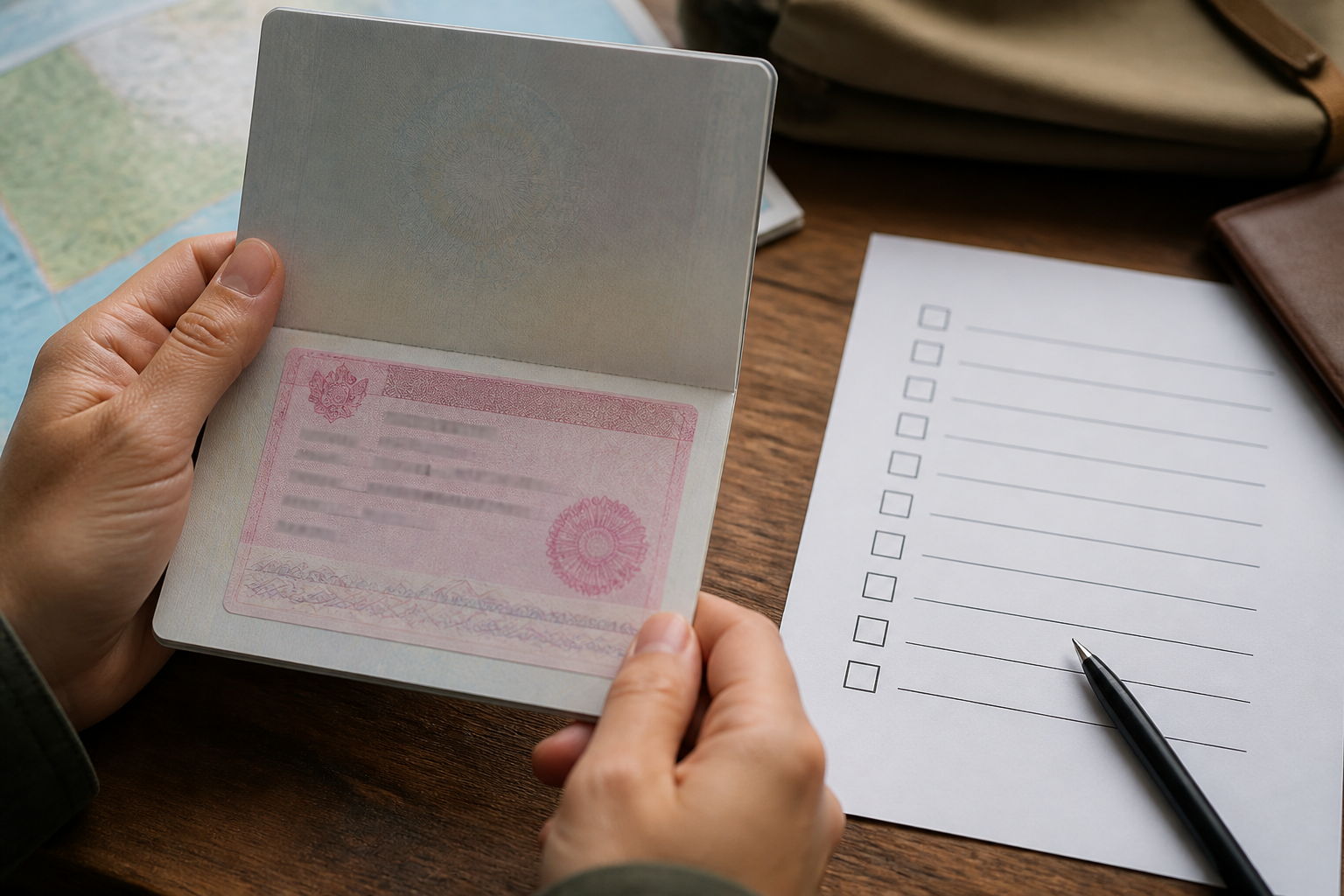
Person checking visa sticker fields against a printed checklist
Verify name, entries, enter-before date, and duration of stay the day you collect.
After the Visa — Arrival Card & Entry
After passport pickup, file the free Arrival Card before landing (official portal) and keep the QR offline. Immigration and hotel registration: China Entry & Exit Rules.
Common Application Mistakes to Avoid
- Treating COVA pre-check as final approval
- Mismatched dates between COVA, flights, and invitation letter
- Applying at the wrong consular district
- Submitting a passport with insufficient validity or no blank page
- Using a non-official COVA website
- Missing biometrics appointment and assuming an agent can substitute without exemption
- Not checking the vignette until check-in counter at the airport
Invitation Letter — What to Include & Who Can Issue
An invitation letter (邀请函) is one of the most important supporting documents for many China visa categories. It connects your application on paper to a real host, company, or itinerary in mainland China. Consular officers use it to verify purpose of visit, visit duration, and who bears expenses.
For L (tourist) visas, an invitation can replace self-booked flight and hotel printouts at many posts (outside the United States, where tourist files are often simplified). For M, F, Q, and S visas, an invitation is usually mandatory.
Tip: The letter must match your COVA form dates and passport details exactly. Inconsistencies are a top reason for delays.
Sample invitation letter layout with applicant block, visit plan, and company chop area (personal data blurred)
Complete fields and a proper stamp save weeks of back-and-forth.

1. When Do You Need an Invitation Letter?
| Visa type | Invitation typically required? |
|---|---|
| L — Tourism | Often optional if you provide flights + hotels; required at some posts; often waived for U.S. tourist applicants |
| M — Business | Yes — from Chinese trading partner |
| F — Exchange | Yes — from hosting entity |
| Q1/Q2 — Family | Yes — from Chinese relative |
| S1/S2 — Dependents | Yes — from principal permit holder |
| Z, X, R | Use category-specific letters/notices, not generic tourist invites |
If you are visa-free eligible for a short leisure trip, you do not need an invitation letter for entry—though carrying host contact details can still help at the border.
2. Required Fields — Applicant Information
The letter must identify the visa applicant precisely as shown in the passport:
- Full legal name (surname and given names in passport order)
- Gender
- Date of birth (YYYY-MM-DD format is clearest)
- Nationality
- Passport number
- Passport validity (optional but helpful at some posts)
Consistency check: Every field must match your passport biodata page and COVA application character for character.
3. Required Fields — Visit Plan
The visit section explains why and when you are coming:
- Purpose of visit (tourism, business meetings, family visit, exchange program—aligned with visa category)
- Arrival date and departure date in China
- Cities or places to visit (Beijing, Xi'an, Shanghai, Guilin, etc.)
- Relationship to inviter (friend, business partner, employee, family member)
- Who pays expenses (applicant self, inviter, company, shared)
For multi-city tours, list primary cities rather than every hour of the itinerary— but dates must cover your full stay.
Tip: If your real plan includes Tibet, note that a mainland L visa or invitation does not replace a Tibet Travel Permit—that is a separate approval through a licensed operator.
4. Required Fields — Inviter Information
4.1 Company / Organization Inviter
For M, F, or agency-issued L letters:
- Full legal name of company or institution (Chinese + English if possible)
- Registered address in mainland China
- Telephone and email contact
- Unified Social Credit Code or business registration number (often included on letterhead)
- Official company stamp (公章) on the letter
- Signature of legal representative or authorized signatory with printed name and title
Use letterhead where possible. The stamp must be clear and match the entity name.
4.2 Individual Inviter (Personal Invitation)
For L, Q, or personal F visits:
- Inviter's full name
- Chinese national ID number (copy usually attached) or foreign permanent residence ID for eligible foreign residents in China
- Address and phone number in China
- Handwritten signature (and sometimes fingerprint or local notarization for Q1—check consulate)
Attach a copy of the inviter's ID (front/back) unless your post says otherwise.
5. Format, Language & Original vs Copy
Language: English alone is accepted at many Western-facing posts; Chinese, or bilingual Chinese–English, is safest when the inviter is a mainland entity.
Format:
- Dated within a reasonable window (often within 3–6 months of application—confirm locally)
- Signed and stamped before scanning for COVA upload
- One page is fine for simple tourist invites; business letters may run longer
Original vs copy:
- COVA upload: scanned PDF or JPG usually sufficient for pre-check
- Submission counter: many posts accept printed copies; others demand the original letter with wet stamp
- Faxed or emailed letters are sometimes accepted if clearly stamped—verify with your CVASC
Tip: Ask your inviter to mail the original if your post requires it, and upload the scan for COVA in parallel.
Company chop impression next to signature line on invitation letter
A missing or unclear stamp is one of the fastest ways to trigger a document request.

6. Who Can Issue an Invitation?
Licensed travel agencies & tour operators
- May issue tourist (L) invitations tied to a confirmed itinerary
- Must be a legally registered mainland travel business with appropriate credentials
- East Marvel can assist with invitation letters when you book a private or small-group tour with us and your consulate expects one
Chinese companies
- Issue M (business) invitations for trade partners, clients, or conference attendees
- Issue F (exchange) invitations for non-commercial programs they host
Chinese individuals
- Friends or relatives can invite for L or Q visits
- Must provide ID copy and accurate contact details
Universities & institutions
- Issue X (study) and F (exchange) invitations through official admission or exchange channels
Who cannot substitute:
- Hotels alone (a booking confirmation is not an invitation letter)
- Random online "invitation letter sellers" with no real itinerary or host relationship—high fraud risk and possible refusal
7. Sample Structure — Tourist (L) Invitation
Use this outline; adapt to your inviter's letterhead:
[Letterhead / Company or Personal Header]
Date: YYYY-MM-DD

To: [Consulate General of PRC in ___ / Visa Section]

Re: Invitation Letter for [Applicant Full Name]

Applicant Information:
Name: ___
Gender: ___
Date of Birth: ___
Nationality: ___
Passport No.: ___

Visit Information:
Purpose: Tourism
Dates in China: [Arrival] to [Departure]
Places to visit: Beijing, Xi'an, Shanghai
Expenses: Borne by applicant / by inviter
Relationship: Client of travel agency / Friend of inviter

Inviter Information:
Name/Organization: ___
Address: ___
Tel: ___  Email: ___

We guarantee the applicant will comply with Chinese laws and leave before the authorized stay expires.

[Stamp — if organization]
[Signature]
Name and Title of Signatory
8. Sample Structure — Business (M) Invitation
Business letters add commercial context:
- Brief description of business relationship
- Meeting dates, venue, and agenda summary
- Statement that the visit involves no direct employment in China (if true)
- Company registration details on letterhead
The Chinese partner should issue the letter—not the foreign applicant drafting it alone.
9. East Marvel — When We Can Help
East Marvel does not issue visas and cannot guarantee consular approval. When you book a confirmed tour with us, we can:
- Confirm whether your nationality and route need an L visa vs visa-free entry
- Provide an invitation letter aligned with your booked cities and dates when your consulate requires one
- Keep letter dates consistent with your COVA application and flight plan
We typically cannot:
- Issue invitations without a confirmed booking
- Provide business M letters for trade visits unrelated to our tours
- Override consular decisions or expedite embassy processing
Tip: Start your visa conversation when you request a quote—not 48 hours before your CVASC appointment.
10. Common Invitation Letter Mistakes
- Missing company stamp or illegible chop impression
- Wrong passport number or name order
- Visit dates shorter than COVA or flight bookings
- Purpose says "tourism" but visa category is M, or vice versa
- Inviter address is outside mainland China for a domestic host letter
- No inviter ID copy attached for personal invitations
- Letter dated more than 6 months before application (some posts reject)
- Using a template in only Chinese when the reviewing post prefers English
Chinese Embassies, Consulates & CVASC
China visa applications are local. You must apply through the diplomatic mission or authorized Visa Application Service Center (CVASC) that has jurisdiction over your place of legal residence—not simply the nearest office on a map, and not necessarily the embassy in your country of citizenship if you live elsewhere.
Getting jurisdiction wrong wastes appointment slots, fees, and weeks of processing time. This guide explains how to find the right office, CVASC vs embassy roles, and practical appointment tips for a smooth submission.
Tip: Always use links from visaforchina.cn or mfa.gov.cn—third-party "visa expediters" may use outdated jurisdiction charts.
Exterior of a Chinese Visa Application Service Center with signage in English and Chinese
Your legal address—not your citizenship alone—determines which center serves you.

1. Embassy vs Consulate vs CVASC — Who Does What?
Chinese Embassy
- Usually located in the capital of a country (e.g., Washington D.C., London, Canberra)
- Handles diplomatic functions and some visa applications directly
- May serve applicants nationwide or defer routine visas to consulates/CVASC
Chinese Consulate General / Consulate
- Located in major non-capital cities (e.g., New York, Houston, Manchester, Sydney)
- Each covers a defined consular district (states, provinces, regions)
- Processes visas for residents within that district
CVASC (Chinese Visa Application Service Center)
- Third-party service center authorized to collect applications on behalf of the consulate
- Provides appointment booking, document checking, fee collection, and passport return logistics
- Does not decide visa approval—the consular section does
- Operates in many countries under brands linked to visaforchina.cn
Typical flow at CVASC countries:
- Applicant completes COVA online pre-check
- Books CVASC appointment
- Submits passport and documents at CVASC
- CVASC forwards to consulate for decision
- Applicant collects passport at CVASC or via courier
2. Jurisdiction — Apply Where You Legally Reside
Apply in the consular district of your legal residence. Detailed rules for non-citizens and temporary visitors are in Step 1 — Confirm Your Jurisdiction above. Below: how to find the correct mission and CVASC vs embassy differences.
3. How to Find Your Correct Mission
Method 1 — visaforchina.cn (fastest for CVASC countries)
- Go to https://www.visaforchina.cn/
- Select your country
- Choose your city or nearest CVASC
- Read the jurisdiction list (often PDF or webpage mapping states/provinces)
- Follow the link to COVA and local checklists
Method 2 — MFA missions directory
- Visit Ministry of Foreign Affairs – Overseas Missions
- Navigate to embassies/consulates in your country
- Open the English visa section of the correct post
- Download the latest L visa / tourist visa notice
Method 3 — Embassy FAQ pages
Many embassies publish "Which consulate serves my state?" charts—for example:
- Embassy of China in Singapore – visa types & application (reference format for document lists)
- U.S., UK, Canada, Australia embassy sites maintain district maps updated periodically
4. CVASC vs Applying Directly at the Consulate
| Factor | CVASC | Consulate direct |
|---|---|---|
| Availability | Common in UK, EU, Australia, parts of Asia | Some countries only use embassies |
| Appointments | Usually mandatory online | Varies—appointment or walk-in |
| Service fee | Yes, on top of visa fee | May be lower or different payment flow |
| Document pre-check | Counter staff may catch missing items | Consular window staff |
| Decision authority | Forwards to consulate | Consulate decides |
| Passport return | Counter, courier, or agent | Mail or counter |
When CVASC helps: structured appointments, clearer checklists, English-speaking counter staff in major cities.
When to read consulate notices anyway: Biometrics exemptions, nationality-specific rules, policy changes are posted on embassy websites first—CVASC implements them but may lag by days.
5. Appointment Tips — Save Time & Avoid Rejection
Before booking
- Complete COVA pre-check first—many centers will not accept walk-ins without online clearance
- Scan documents at 300 dpi; fix COVA errors before paying for an appointment
- Read the photo spec for your specific center
Booking strategy
- Book the earliest slot after pre-check clears—even if your trip is weeks away, slots fill in peak season
- Choose a center inside your district; staff may turn away out-of-district applicants at the door
- If family/group applying, check whether one appointment per passport is required
Day of appointment
- Arrive 15–20 minutes early with originals + copies in a labeled folder
- Bring payment card/cash as listed—some centers are cashless
- Wear clothing that allows fingerprint scanning if biometrics required
- Ask for receipt showing expected pickup date
If no appointments available
- Check daily—cancellations release slots
- Ask whether mail-in submission is permitted for your nationality
- Consider whether authorized agents can submit (where legal and when biometrics exempt)—not available everywhere
Tip: Never miss an appointment without canceling—some centers block rebooking after no-shows.
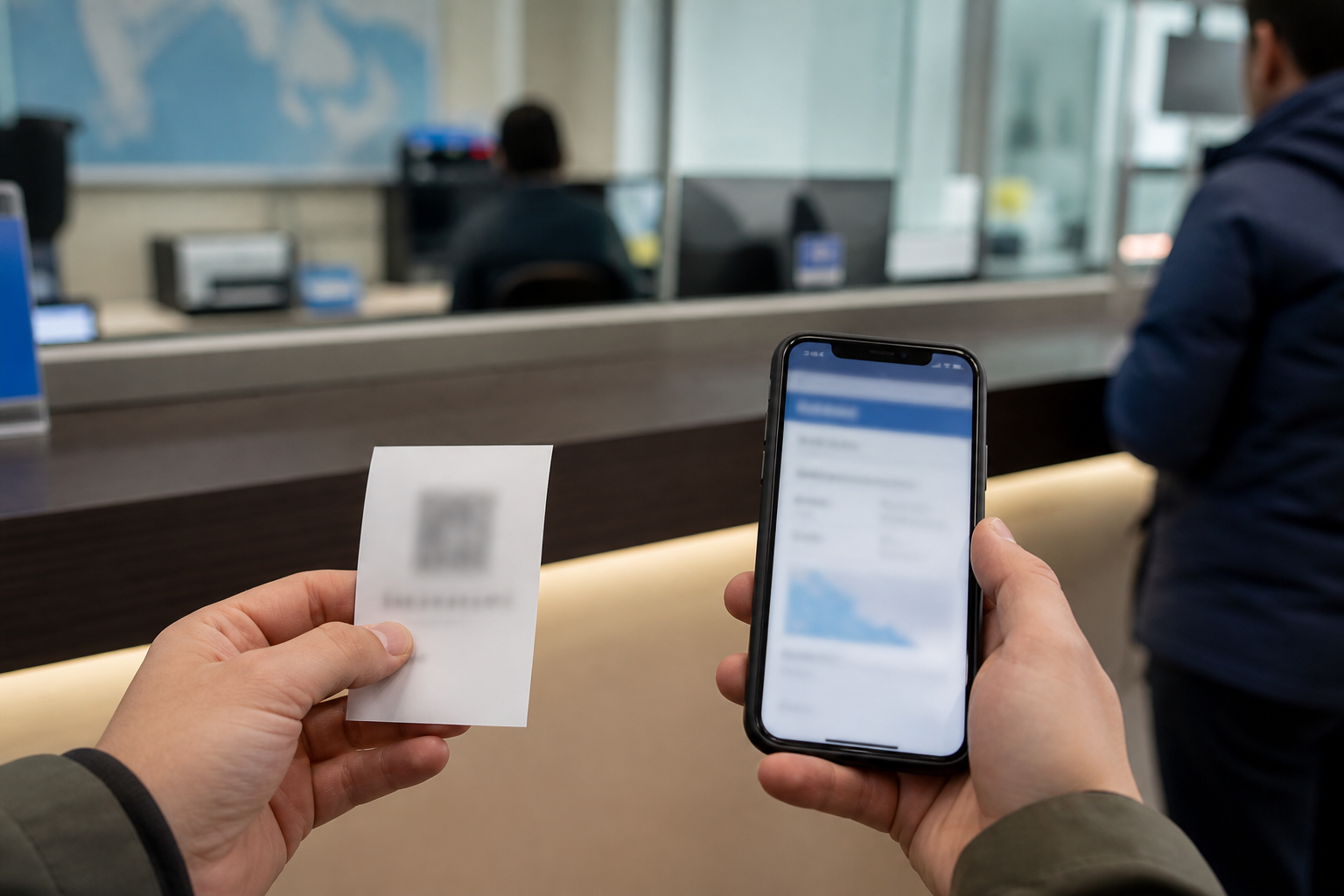
Queue ticket and appointment confirmation on phone at visa center reception
Arrive early with COVA barcode, passport, and payment ready.
6. Country Snapshots — Patterns (Verify Locally)
These are patterns, not universal law—always confirm on your post's site:
United States
- Multiple consulates (New York, Washington, Chicago, San Francisco, Los Angeles, etc.) + CVASC partners
- Tourist L visa files often simplified—no flight/hotel/itinerary
- Strict district assignment by state of residence
United Kingdom & Ireland
- CVASC in London, Manchester, Edinburgh (coverage varies)
- Online COVA + appointment standard
European Union
- Often one CVASC hub per country or shared regional centers
- Schengen residence permit commonly required for non-EU citizens applying locally
Australia & New Zealand
- Consulates in Sydney, Melbourne, Perth, etc., with clear state/territory maps
Southeast Asia (e.g., Singapore)
- Embassy handles visas for residents in its jurisdiction; detailed document lists online (Singapore Embassy visa page)
7. Mail-In, Agents & Third-Party Services
Mail-in submission: Some posts allow applicants in remote districts to mail passports after COVA pre-check. Courier both ways adds days and risk—use trackable shipping and insurance.
Authorized agents: Visa agencies licensed in certain countries may submit on your behalf when biometrics are exempt or already on file. The applicant remains responsible for document accuracy.
Third-party "invitation sellers" or fake COVA sites: Avoid. Use only embassy-linked portals.
East Marvel does not submit passports on your behalf—we help with itinerary and invitation letters when you book tours.
8. What to Read on the Embassy Website Before You Apply
Checklist of pages worth opening:
- Consular district map for your address
- Latest L visa / tourist visa notice (dated within months)
- COVA link and photo specifications
- Fee table by nationality and entries
- Biometrics / fingerprint policy current notice
- Holiday closure calendar
- Visa-free policy FAQ if you might not need a visa (MFA notice)
Screenshot the pages that apply to your nationality and travel dates.
Shenzhen Port Visa & Landing Visa Limits
Search online for "China visa on arrival" and you will find blog posts suggesting you can land in Shenzhen and pick up a visa at the border. That advice is misleading at best and trip-ending at worst.
China's port visa (口岸签证) is an emergency, restricted pathway for foreigners who urgently need to enter but could not obtain a visa overseas in time. It is not the same as the casual visa-on-arrival (VOA) systems in many other countries. Separately, Shenzhen has a history of Special Economic Zone (SEZ) / limited-area landing visas with strict geographic caps—a different concept again.
This guide explains port visa hard limits, Shenzhen-specific context, Luohu and Shekou, when a port visa might apply, and why Plan A should always be a proper L visa or visa-free entry applied for before departure.
Tip: If your entire China holiday depends on getting a visa at the airport or Luohu checkpoint, you are carrying refusal risk that no reputable tour operator should build into a standard itinerary.
Shenzhen Luohu border crossing exterior with directional signage (wide shot, no close-up faces)
Border counters are not a backup plan for tourists who skipped the embassy.
1. Port Visa ≠ General Visa-on-Arrival
| What travelers assume | What China actually offers |
|---|---|
| Any tourist can get a visa at the border | Port visa only for eligible urgent cases with prepared materials |
| Valid at any airport in China | Usually must enter through the same port that issued the visa |
| Unlimited 30–90 day holidays | Often enter within 15 days of issuance; max stay ~30 days |
| Pay fee and walk through | Refusal is possible—no guaranteed entry |
| Works for multi-city tours | Poor fit for Beijing–Xi'an–Shanghai style routes unless you hold a normal visa |
Official framing: Port visas address situations such as emergency business, humanitarian needs, or inability to apply abroad in time—not convenience shopping for spontaneous tourists.
Reference context: Hainan government port visa explainer; China visa & entry hub.
2. Hard Limits on Port Visas — Know Before You Fly
Based on consular practice and operator guidance commonly cited in border procedures:
Entry window
- Must usually enter China within 15 days of port visa issuance
- Missing that window invalidates the permission
Duration of stay
- Maximum stay commonly about 30 days (officer decides exact length)
- Not designed for long-term residence or repeat back-to-back use
Port restriction
- Enter through the issuing port—a port visa issued at Beijing does not authorize first entry at Shanghai
- Exceptions may exist for certain organized group arrangements under specific rules—never assume for independent travel
Preparation timeline
- Materials often must be prepared before arrival, frequently with 10+ working days of lead time involving a licensed agency in China
- "I will sort it at the airport counter" is a common failure mode
Refusal risk
- Officers can deny port visa issuance or deny entry if purpose, documents, or nationality do not qualify
- Non-refundable flights and hotels remain your loss
Cost
- Fees apply at the border; totals vary by nationality and entries—still not cheaper than planning an overseas L visa (~USD 150–300 all-in at CVASC in many Western countries) when you count risk and last-minute agency fees
Tip: Treat port visa as Plan C, not Plan A. Plan A: 30-day visa-free if eligible. Plan B: overseas L visa ~1 month before travel.
3. Which Ports May Process Port Visas?
Ports commonly cited in official and operator guidance as having port visa capability include (always confirm live before relying):
- Beijing
- Shanghai
- Tianjin
- Dalian
- Fuzhou
- Xiamen
- Xi'an
- Guilin
- Hangzhou
- Kunming
- Guangzhou (Baiyun Airport)
- Shenzhen — Luohu (罗湖), Shekou (蛇口), and other designated checkpoints
- Zhuhai — Gongbei (拱北)
Not every immigration counter at these cities handles every case. Air vs land vs sea ports differ. Call your receiving agency and border authority through official channels—not a travel forum.
[Photo] Map pin graphic highlighting Shenzhen Luohu and Shekou relative to Hong Kong border
Shenzhen port options are geographically specific—not "any Shenzhen airport lane."
4. Shenzhen Context — Three Different Ideas Travelers Confuse
Shenzhen appears in visa discussions for three separate reasons. Do not mix them:
4.1 Nationwide port visa at Shenzhen checkpoints
- Emergency port visa processing may be available at designated Shenzhen ports such as Luohu and Shekou for qualifying applicants with prepared files
- Same restrictions as nationwide port visa: urgency, materials, port match, refusal risk
4.2 Historical SEZ / limited-area "landing visa"
- Shenzhen historically offered Special Economic Zone visas allowing short stays confined to Shenzhen (sometimes issued at the border for certain nationalities under reciprocal, limited schemes)
- Geographic restriction: travel outside Shenzhen (e.g., Guangzhou, Beijing) may be illegal without converting status
- Policies change, nationality-specific, and tightened over time—never treat Wikipedia or 2015 blog posts as current law
4.3 Normal entry via Shenzhen with a regular visa or visa-free policy
- Most East Marvel guests enter Shenzhen (or any city) with:
- 30-day unilateral visa-free if nationality qualifies, or
- L visa issued overseas, or
- 240-hour transit visa-free with eligible onward ticket
This is the path we recommend.
Tip: Hong Kong is a separate immigration system. A visa-free Hong Kong entry does not authorize mainland China entry. Crossing at Luohu / Futian / Huanggang / Shekou requires mainland eligibility.
5. Luohu & Shekou — Practical Notes for Hong Kong Gateway Travelers
Many Hong Kong–based or Hong Kong-transit travelers look at Luohu (罗湖) and Shekou (蛇口) as possible visa counters.
Luohu:
- Major land border between Hong Kong (Lo Wu / Lok Ma Chau connections) and Shenzhen
- Heavy foot traffic; not a casual tourist visa desk for unprepared applicants
- Any port visa or SEZ scheme requires pre-qualified documents—confirm with official sources same week
Shekou:
- Ferry and port area linking Hong Kong–Macao–Shenzhen routes
- Port visa handling depends on ferry vs immigration lane and current policy—do not assume ferry ticket = visa service
Better approach for leisure travelers:
- Confirm mainland entry status before boarding the MTR, bus, or ferry
- If you need a visa, obtain an L visa at your home CVASC (~4–5 working days after submission)
- Complete the free Arrival Card before immigration

6. When Might a Port Visa Actually Apply?
Legitimate scenarios sometimes cited (each requires verification):
- Emergency business visit with sponsoring Chinese entity and pre-filed materials
- Humanitarian / family emergency with supporting documentation
- Technical inability to reach an embassy before travel (with agency sponsorship)—still not guaranteed
- Certain pre-arranged group port visas organized by licensed travel agencies for tour groups
Poor fit:
- Standard two-week China highlights tour booked on a whim
- Digital nomad hoping to "try China" without prior visa
- Travelers who simply forgot to apply and assume the border will forgive
For group tours, agencies must usually pre-arrange port visas with immigration—this is not walk-up tourism.
7. Why Plan A Should Be an Overseas L Visa (or Visa-Free)
| Factor | Overseas L visa / visa-free | Port visa gamble |
|---|---|---|
| Certainty | High when documents correct | Low — refusal possible |
| Multi-city routes | Yes, with normal visa or waiver | Often blocked or legally risky |
| Lead time | ~1 month planning; 4–5 day processing | Still needs 10+ days prep for many port cases |
| Cost predictability | USD 150–300 typical at CVASC | Visa fee + agency rush fees + sunk flights |
| East Marvel tours | Designed around confirmed entry status | We do not build standard tours on port visa hope |
Apply through visaforchina.cn in your consular district. Need an invitation letter? East Marvel can assist after booking.
8. If You Are Already in Hong Kong Without a Mainland Visa
Do not assume you can obtain a mainland visa in Hong Kong unless your nationality is on a current, verified list for Hong Kong-issued visas (policies fluctuate; many nationalities cannot apply in HK).
Safer options:
- Return home or travel to a country where you legally reside and apply at the proper CVASC
- Postpone mainland segment until L visa is in passport
- Re-route to destinations you can enter legally today
Calling a +86 immigration hotline from abroad is difficult—plan before buying cross-border tickets.
Tip: 12367 is the NIA hotline inside China. Before entry, rely on embassy websites and your booking agent.
9. After Entry — Registration, Stay Limits & Exit
If you enter on any visa or waiver:
- Respect duration of stay on the stamp or vignette
- Complete Arrival Card (free, official portal only)
- Hotels register you; private stays need police registration within required time
- SEZ-limited visas (if ever issued) restrict movement—traveling to Guangzhou or Beijing without conversion is non-compliant
- Overstay penalties include fines, detention, and future visa refusal
China Visa FAQ & Practical Tips
Questions already covered in the application steps above (100% online filing, how far in advance) are omitted here.
Visa rules generate more last-minute panic than almost any other China travel topic. This FAQ collects the questions East Marvel guests ask most often— with practical answers grounded in current consular practice, COVA application flow, and NIA entry procedures.
Tip: Policies change. Cross-check answers against your embassy/CVASC page the week you travel.
Traveler FAQ-style graphic: passport, phone with Arrival Card QR, and question-mark icon
When in doubt, verify with official sources—not a 2019 forum thread.
1. How Much Does a China Visa Cost?
Typical range for many Western applicants: roughly USD 150–300 all-in, including:
- Visa fee (varies by nationality, entries, and processing speed)
- CVASC service fee
- Optional courier return fee
Factors that change price:
| Factor | Effect |
|---|---|
| Nationality | Fee tables differ (e.g., U.S., UK, EU, Australian passports) |
| Entries | Single vs double vs multiple |
| Processing | Standard (~4–5 working days) vs express |
| Country of application | Same nationality, different CVASC country → different totals |
Check the fee page of your specific center before appointment. Cash/card rules vary.
Tip: Third-party agencies add their own service fees on top—budget separately if you use one.
2. Do U.S. Tourists Need Flight & Hotel Documents?
Often no—for L visa applications at Chinese missions in the United States.
U.S. consular posts have simplified tourist files: applicants are generally not required to submit flight, hotel, itinerary, or invitation for L visas. You typically submit what that post lists—commonly passport, COVA form, photo, and prior China visa copy if any.
Critical caveat: Rules can change. Read your specific consulate page (New York, Washington, Chicago, San Francisco, Los Angeles, etc.) the same week you apply.
At the border: Even without embassy submission requirements, carrying onward tickets and hotel confirmations still helps immigration officers verify purpose—especially if questioned.
3. Can I Extend My Stay in China?
Depends on entry type:
Visa-free (30-day unilateral, 240-hour transit, Hainan waiver)
- Overstay is not casually extendable for tourism
- Extensions require justified reasons and application to local exit-entry administration—approval not guaranteed
- Plan to leave before the waiver expires
L or other visas
- If you need to stay beyond "Duration of each stay" on the vignette, apply for an extension or stay permit at local exit-entry police before the current stay expires
- Requires supporting reasons (medical, humanitarian, etc.)—** tourism extensions are difficult**
- Working on tourist stay is never a valid extension reason
Tip: The safest strategy is applying for the correct entries and stay length upfront, or leaving and re-entering only if your visa category and entries allow.
4. Multiple Entry — Can I Come Back?
On a visa: Check the vignette:
- Entries: 1 (single), 2 (double), or M (multiple)
- Enter Before: last entry date
- Duration of each stay: days per visit
A one-year multiple-entry L with 30-day stay allows repeated visits until the enter-before date, each visit ≤30 days (unless officer wrote otherwise).
On visa-free: MFA guidance currently allows multiple entries for eligible 30-day waiver nationalities with no stated cap—but purpose must remain tourism/business visit/etc., not de facto residence. Frequent back-to-back trips may trigger extra questioning.
Applying for multiple entry: Request on COVA; approval not guaranteed—consulates want justification (repeat business, split itineraries).
5. Lost Passport in China — What Now?
Step-by-step:
- File a police report immediately (obtain a police report certificate)
- Contact your embassy/consulate in China for an emergency travel document or replacement passport
- Visit local exit-entry administration with police report, photos, and emergency document to regularize status
- Do not attempt to fly on a cancelled passport or without exit clearance
- Allow several days to 2+ weeks depending on embassy workload
Prevention: Keep digital and paper copies of passport bio page, visa, and entry stamp separate from originals. Email copies to yourself before departure.
6. Cruise Ship Entry — Do I Need a Special Visa?
It depends on the itinerary and immigration classification:
- Same cruise in-and-out with no disembarkation beyond permitted shore excursions may fall under special group or cruise arrangements—handled by the cruise operator with Chinese authorities in advance
- Independent travelers joining a cruise that starts or ends in mainland China, or combining cruise + multi-city land tour, usually need a normal L visa (or visa-free eligibility) like any other visitor
- 240-hour transit visa-free generally requires confirmed air/land onward ticket to a third country—cruise-only loops may not qualify unless your specific routing meets NIA rules
Action item: Send your full cruise + land itinerary to the cruise line's visa desk and verify with your embassy. Do not rely on "the ship said visa-free."
Tip: Yangtze river cruises between Chongqing and Yichang still require lawful mainland entry status before boarding—usually L visa or eligible waiver.
7. Can I Apply in a Country I Am Just Visiting?
Usually no. CVASC and consulates expect applications from people with legal residence in that country—not tourists passing through on a short visit visa.
Exceptions sometimes exist for:
- Long-term work or study visa holders with local address proof
- Specific ** bilateral arrangements** (rare for tourists)
Apply in your home country or country of residence per jurisdiction rules.
8. Will a Criminal Record or Prior Refusal Block Me?
Prior visa refusal:
- Not an automatic permanent ban, but you must disclose accurately on future applications
- Fix the root cause (wrong category, bad invitation, inconsistent dates) before reapplying
Criminal history:
- Serious offenses can result in refusal—consulates may ask about convictions depending on form questions
- Answer truthfully; misrepresentation is worse than a past record
Overstay history:
- Prior overstays in China strongly hurt future applications—officers see immigration records.
9. Do Children and Infants Need Visas?
Yes, unless the child qualifies for the same visa-free or transit waiver as an adult under current MFA rules (FAQ).
Minors applying for visas need:
- Child's passport
- Birth certificate
- Parental consent if one parent applies alone
- Same category supporting documents as adults
Arrival Card: Minors typically need filing too unless covered by a parent/guardian exemption listed by NIA—when unsure, file.
10. Practical Tips — Before, During & After Entry
Before departure
- Screenshot MFA visa-free notice if using waiver
- Verify vignette: name, entries, enter-before, stay duration
- Bookmark official Arrival Card URL
- Notify your bank; pack travel insurance (often required for L visa files abroad)
At immigration
- Present passport, visa/waiver proof, Arrival Card QR
- Answer purpose questions consistently with visa type
- Keep entry stamp photo
After entry
- Hotel registration (or police registration for private stays)
- Carry hotel address in Chinese
- Do not work on tourist or visa-free entry
- For Tibet: add Tibet Travel Permit via licensed operator—mainland visa alone is insufficient
What not to do
- Do not trust "visa on arrival" blogs for mainland leisure travel—see port visa limits
- Do not use paid Arrival Card clone sites
- Do not overstay "because the flight was delayed one day" without formal extension
Related reading (this 4-part series)
- China Visa-Free Entry Guide
- China Visa Types & Requirements
- China Visa Application Guide
- China Entry & Exit Rules
Official sources hub
- National Immigration Administration (NIA): https://www.nia.gov.cn/
- Arrival Card (free): https://s.nia.gov.cn/ArrivalCardFillingPC/
- General Administration of Customs (GACC) English: http://english.customs.gov.cn/
- State Taxation Administration (STA) tax refund: https://www.chinatax.gov.cn/eng/c101276/c102444/c5240901/content.html
- Customs Announcement 43 (2025): https://www.gov.cn/zhengce/zhengceku/202504/content_7017195.htm
- MFA visa-free FAQ: https://www.mfa.gov.cn/wjbzwfwpt/kzx/tzgg/202511/t20251110_11749824.html
- Visa Application Service Center (COVA): https://www.visaforchina.cn/
Plan with East Marvel
Practical tips—not legal advice. For itinerary review and tax-refund-friendly routing: