
China Visa Checklist & When You Need an L Visa
Not sure yet whether you need a visa at all? Check your route on Do I need a visa for China? first. Visa-free paths are in China Visa-Free Entry Guide. This article covers preparation, visa letters, and document packs.
China's entry rules in 2027 are more flexible than a decade ago—yet more complex than a single "visa or no visa" headline suggests. This page is the hub overview for first-time travelers: every major lawful path, how they differ, what documents to carry, and how East Marvel fits into your planning. Use it alongside our deep-dive articles linked below.
Tip: Policies change without much fanfare. Reconfirm your nationality and itinerary on NIA and MFA the week you travel.
1. Pre-departure checklist (all travelers)
Documents
- Passport valid 6+ months beyond trip with blank visa page(s)
- Entry path confirmed in writing (visa vignette, or policy name + eligibility notes)
- Return or onward ticket matching the policy you will claim
- Hotel addresses in English and Chinese (first night minimum)
- Invitation letter if visiting friends or if consulate required it for L visa
- Travel insurance certificate (recommended even when optional)
Digital
- Arrival Card filed at s.nia.gov.cn/ArrivalCardFillingPC — QR saved offline
- Passport bio-page photo in cloud + email
- Payment apps set up (Alipay / WeChat Pay) or cash plan
- eSIM or roaming for maps and translation
Special cases
- Tibet: Tibet Travel Permit arranged via licensed operator—not included in any visa-free stamp
- Transit: Verify both entry and exit ports are eligible; ticket shows third country/region
- Hainan: Confirm direct Hainan port entry—not mainland first
- Tax refund shopping: Shop at designated stores; keep invoices if claiming VAT refund on departure
2. Tourist (L) visa — when you need it
Apply for an L visa when your nationality is not covered by a waiver that fits the trip (e.g., United States multi-city tours), you need a longer stay / multiple entries, or your purpose is not covered by a waiver (work, journalism, long study).
U.S. simplification: Tourist applicants at U.S. posts generally omit flight/hotel bundles—re-read your consulate page the week you apply.
COVA filing, fees, biometrics, vignette checks: China Visa Application Guide. Category letters and document packs: sections below.
East Marvel provides invitation-letter support for booked itineraries when needed. We do not issue visas.
3. Extending stay, overstays, and corrections
- Visa-free or transit: Overstaying is serious—fines, exit difficulties, future visa impacts. Need more time? Apply for a stay permit at local Exit-Entry Administration before expiry, with justified reason and supporting documents.
- L visa: Duration printed on visa is the default maximum; extensions follow similar stay-permit routes.
- Changing purpose (e.g., tourism → business meeting that becomes contract negotiation) may require a different visa—do not improvise.
4. How East Marvel helps (without issuing visas)
We are a travel advisor and tour operator, not a consulate. Practical support includes:
- Entry-path review for your nationality, cities, and dates
- Itinerary design that matches the policy you will use at the border
- Invitation letters when you book a private or small-group tour and your visa file requires one
- Tibet coordination with licensed partners when Tibet is in scope
- Airport pickup, guides, and trains aligned to your entry port and Arrival Card timing
Start here: chinatour.eastmarvel.com — Trip List inquiries typically receive a custom reply within 24 hours.
China Visa Types Explained (L, M, F, Z, X, Q, S & More)
China issues visas by purpose of stay, not by nationality alone. If you are not covered by a 30-day unilateral visa-free policy, 240-hour transit visa-free, or another exemption, you must apply for the correct ordinary visa category at a Chinese embassy, consulate, or Visa Application Service Center (CVASC) before travel.
Choosing the wrong type is one of the most common—and most expensive—mistakes travelers make. A tourist who applies for a business visa without genuine trade activity, or a visitor who enters on an L visa and then tries to work, can face refusal, cancellation, or serious immigration consequences.
Tip: Consular officers decide the final visa category and validity. Your application category is a request; supporting documents must match your real itinerary and purpose.
Passport open to a China visa vignette beside a printed visa category chart
Each visa letter corresponds to a specific purpose—match yours before you file.

1. How China Organizes Visa Categories
Chinese ordinary visas use a letter code system. Each code reflects the primary activity you will undertake in mainland China. Some categories have sub-types (for example, X1 vs X2, Q1 vs Q2) based on intended stay length.
General principles:
- One primary purpose per visa. Mixing tourism with paid employment on a tourist visa is not permitted.
- Supporting documents must align with the category you select on the China Online Visa Application (COVA) form.
- Validity, entries, and duration of stay are decided by the issuing post—not guaranteed at the time you apply.
- Port visas exist for limited emergency cases but are not a substitute for choosing the correct ordinary visa in advance (see our China Visa-Free Entry Guide
Official references: Embassy of China in Singapore – visa types; VisaforChina category overview.
2. L Visa — Tourism & Personal Leisure Travel
The L (旅游) visa is the category most leisure travelers need when visa-free or transit options do not apply.
Typical use cases:
- Multi-city sightseeing holidays (Beijing–Xi'an–Shanghai, etc.)
- Visiting friends without a formal family-reunion visa
- Independent or small-group tourism not covered by visa-free policy
Common supporting documents:
- Round-trip or onward flight booking and hotel reservations, or
- An invitation letter from a mainland host or licensed travel agency
Important note for U.S. applicants: Chinese missions in the United States have often simplified L-visa files—tourist applicants may not need to submit flight, hotel, or itinerary documents. Always confirm on your specific consulate page the week you apply.
Typical processing: Apply about one month before travel; standard turnaround after passport submission is often 4–5 working days; total cost for many Western applicants falls roughly in the USD 150–300 range including center fees.
Tip: An L visa does not authorize work, long-term study, or journalism. If your trip includes business meetings with a Chinese company, consider whether M or F is more appropriate.
3. M Visa — Commercial & Trade Activities
The M (商贸) visa covers commercial and trade activities: meetings, factory visits, negotiations, exhibitions, and market research with a Chinese business partner.
Typical supporting documents:
- Invitation letter issued by the Chinese trading partner (company letterhead, stamp, contact details)
- Sometimes business registration copies, prior cooperation proof, or conference registration
Who should choose M instead of L:
- You have scheduled meetings with a Chinese supplier, client, or distributor
- Your employer is sending you for trade fairs or site inspections
- The primary purpose is business development—not sightseeing
Tip: Border officers may ask about your meetings. Carry the invitation, business cards, and any event badges that corroborate your M visa purpose.
4. F Visa — Non-Commercial Exchanges & Study Tours
The F (访问) visa is for non-commercial exchanges: cultural visits, research exchanges, study tours, sports events, and similar activities that are not standard tourism or paid trade.
Typical supporting documents:
- Invitation from a relevant Chinese entity (university, association, research institute, event organizer)
- Sometimes event schedules, exchange agreements, or group rosters
F vs M vs L — quick distinction:
| Scenario | Likely category |
|---|---|
| Factory sourcing trip with purchase intent | M |
| University delegation cultural exchange | F |
| Independent Great Wall + pandas holiday | L |
5. Z Visa — Employment in China
The Z (工作) visa is required for foreigners who will take up employment in mainland China. It is not interchangeable with L, M, or F visas.
Core supporting documents:
- Notification Letter of Foreigner's Work Permit or Foreigner's Work Permit (issued via China's work permit system)
- Employer sponsorship materials as listed by your consulate
After entry: Z visa holders typically must apply for a Residence Permit at local exit-entry administration within the required timeframe—do not overstay the initial entry window.
Tip: "Digital nomad" work on a tourist or visa-free entry is still treated as unauthorized employment. Plan Z (or another lawful status) if you will be working from China long-term.
6. X1 / X2 — Study Visas
X1 is for long-term study (generally more than 180 days); X2 is for short-term study.
Typical supporting documents:
- Admission letter from a Chinese school or university
- JW201 or JW202 form (for long-term programs, as applicable)
- Proof of financial means and accommodation arrangements when required
Students on X visas must respect enrollment conditions and register with their institution and local police as directed.
7. Q1 / Q2 — Family Visits & Reunion
Q1 covers family reunion with longer intended stays; Q2 covers short family visits.
Typical supporting documents:
- Invitation letter from the Chinese family member
- Inviter's ID copy (Chinese national ID or foreign permanent residence card)
- Kinship proof (birth certificate, marriage certificate, etc.)—especially for Q1
Q vs L for visiting relatives: If your primary purpose is family reunion with extended stay, Q1/Q2 is usually correct. A casual holiday staying with friends may still use L with an invitation letter—confirm with your consulate.
8. S1 / S2 — Dependents of Workers & Students
S1 / S2 visas are for dependents (spouses, children, parents) of foreigners who hold Z, X1, or other long-stay permits in China.
Typical supporting documents:
- Invitation from the principal visa/permit holder
- Relationship proof
- Copy of the principal's work or study permit/residence document
9. R, G, C, J1/J2 — Specialized Categories
R — High-Level Talent
For foreigners recognized as high-level talents or urgently needed specialists. Requires a Confirmation Letter for Foreigner's High-End Talent Status or equivalent materials from authorized channels.
G — Transit
For travelers transiting through China when 240-hour or 24-hour transit visa-free does not apply. Requires confirmed onward tickets to a third country or region.
C — Crew
For airline, shipping, and rail crew members on duty. Issued based on employer/carrier documentation.
J1 / J2 — Journalism
For foreign journalists and media staff. Requires accreditation materials coordinated with Chinese media authorities—ordinary travelers must not use J visas for blogging or casual content creation.
10. Single, Double & Multiple Entry — What the Sticker Means
Beyond the letter category, your visa vignette shows:
- Entries: Single (1), Double (2), or Multiple (M)
- Enter Before: Last date you may enter China
- Duration of Each Stay: Maximum days per entry (often 30, 60, or 90—officer decides)
Planning tip: A single-entry L visa with 30-day stay works for one round trip. Frequent travelers should request multiple entry with justification (repeat business, split itineraries)—approval is not automatic.
Tip: "Duration of each stay" is not the same as visa validity. You can hold a one-year multiple-entry visa where each visit is capped at 30 days.
[Photo] Close-up diagram labeling visa vignette fields: entries, enter-before date, duration of stay
Read all three fields the moment you collect your passport.

11. Which Letter Do You Need?
If a visa-free path does not fit, match purpose to the letter above (L leisure, M trade, F exchange, Z work, X study, Q/S family, etc.). Full waiver decision tree: China Visa-Free Entry Guide.
China Visa Requirements & Documents by Type
Every Chinese embassy, consulate, and Visa Application Service Center (CVASC) publishes a local checklist. Requirements differ by nationality, place of application, and visa category. This guide explains the core documents almost everyone needs, then breaks down category-specific additions so you can assemble a complete file before starting the COVA online application.
Tip: Read your jurisdiction's checklist the same week you apply. Photo dimensions, appointment rules, and U.S. itinerary simplifications change without much warning.
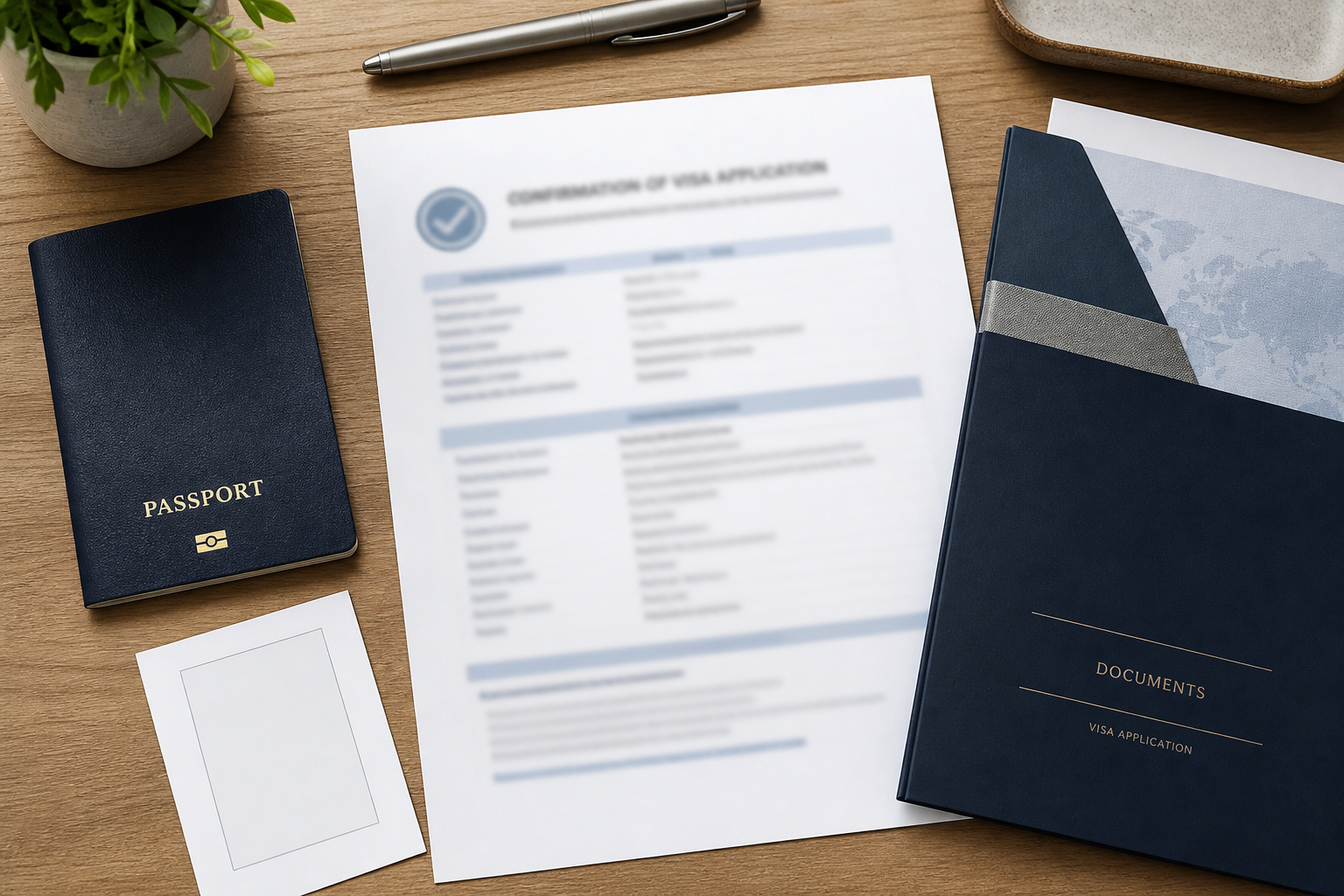
[Photo] Flat-lay of passport, visa photo, printed COVA confirmation, and document folder on a desk
One consistent identity across every page you upload and carry.
1. Universal Requirements — Every Applicant
These items appear on nearly every China visa checklist worldwide:
1.1 Valid Passport (Original)
- Original passport must be submitted (online pre-check alone does not produce a visa).
- Validity: Most posts require the passport to remain valid for at least 6 months beyond your intended stay or visa validity window. Some airlines enforce 6 months even when consular rules are shorter—plan for 6 months as the safe standard.
- Blank pages: At least one blank visa page; some posts ask for two—check locally.
- Condition: No severe damage, missing pages, or unreadable biodata.
- Photocopy: Bring a clear copy of the biodata page even if not always listed.
1.2 Completed Online Application (COVA)
- Fill the official China Online Visa Application form linked from your embassy or CVASC.
- Print the confirmation / barcode page after online pre-check clears you to submit the passport.
- See our step-by-step application guide.
1.3 Visa Photo
- Recent passport-style photo (usually taken within the last 6 months).
- Light-colored background (white or near-white is standard).
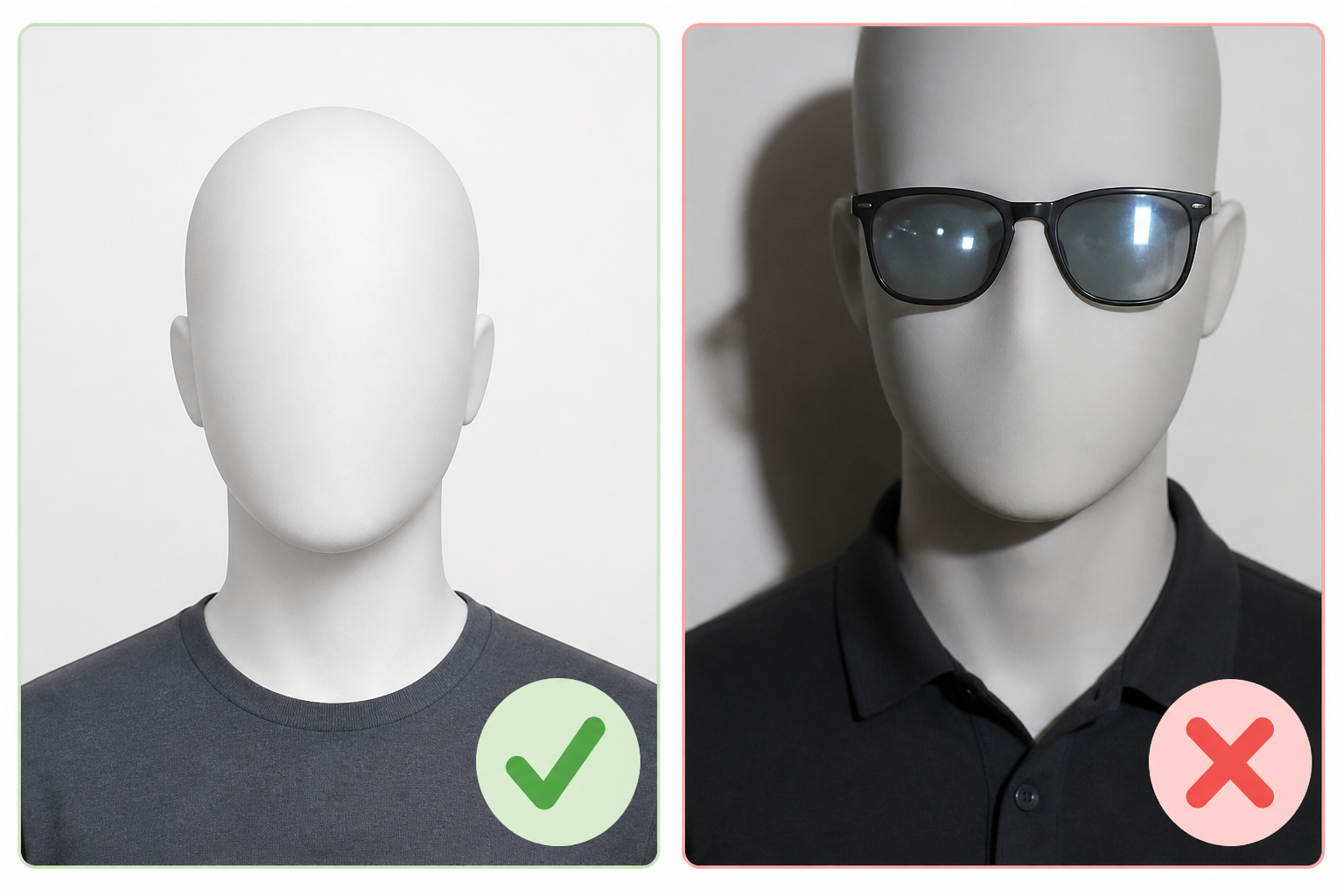
- Full face, no hat, neutral expression; glasses rules vary—many posts discourage heavy frames or glare.
- Digital upload through COVA is mandatory at most centers; some still ask for one printed photo at submission—carry a spare set.
- Size: Commonly 48 mm × 33 mm (width × height) for paper prints, but follow your post's pixel dimensions for digital uploads—do not assume one global standard.
1.4 Proof of Legal Residence (When Applying Outside Your Passport Country)
If you apply in a country where you are not a citizen, posts typically require proof of legal stay, such as:
- Valid residence permit or long-stay visa
- National ID card (where accepted)
- Driver's license plus utility bill
- Employment or enrollment letter with local address
The exact combination is jurisdiction-specific. A tourist applying in a third country while on a short visit visa is often not eligible—apply where you legally reside.
2. Supporting Documents by Visa Category
After the universal core, add materials that match your visa type. Officers may request originals, copies, translations, or an interview at their discretion.
2.1 L Visa — Tourism
Standard package (most countries outside the U.S.):
- Round-trip or onward flight booking (ticketed or reservation—follow local wording)
- Hotel bookings covering main nights, or a detailed day-by-day itinerary
- OR a China invitation letter instead of (or with) self-booked travel proof
U.S. simplified rule (confirm locally):
Chinese missions in the United States have often not required tourist applicants to submit flight, hotel, itinerary, or invitation documents for L visas. U.S.-based applicants should upload only what their specific embassy/consulate page lists—commonly passport, form, photo, and prior China visa copy if any.
Optional but useful:
- Travel insurance certificate
- Copy of previous Chinese visa or residence permit
- Old Chinese passport biodata page if formerly held Chinese nationality
2.2 M Visa — Business / Trade
- Invitation letter from Chinese trading partner on official letterhead
- Company stamp and signature of legal representative
- Sometimes: business license copy, prior contract, exhibition registration, or buyer/seller relationship proof
2.3 F Visa — Non-Commercial Exchange
- Invitation from hosting Chinese entity (institution, association, event organizer)
- Event schedule, exchange agreement, or participant list when applicable
2.4 Z Visa — Work
- Notification Letter of Foreigner's Work Permit or Foreigner's Work Permit
- Additional employer documents per consulate list
2.5 X1 / X2 — Study
- Admission letter from Chinese school
- JW201 or JW202 (long-term programs)
- Financial and accommodation proof when required
2.6 Q1 / Q2 — Family
- Invitation from Chinese relative
- Inviter's ID copy
- Kinship certificates (marriage, birth, etc.)—especially for Q1
2.7 S1 / S2 — Dependents
- Invitation from principal permit holder in China
- Relationship proof
- Copy of principal's work/study permit or residence permit
2.8 R, G, C, J — Specialized
| Type | Key extra documents |
|---|---|
| R | High-end talent confirmation letter |
| G | Confirmed onward ticket to third country/region |
| C | Carrier/employer crew letter |
| J1/J2 | MFA/media accreditation materials |
Full category overview: China visa types guide.
3. Passport Validity — The 6-Month Rule Explained
Consular guidance often states the passport must cover your planned stay plus a buffer—6 months is the practical planning standard used by many posts and airlines.
Check three clocks:
- Passport expiry date vs your last day in China
- "Enter Before" date on the visa vignette (once issued)
- "Duration of each stay" per entry (e.g., 30 days)
Tip: Renew an expiring passport before applying. A visa issued in an old passport may require carrying both passports at entry if you renew mid-process—ask your consulate how to handle transfers.
4. Visa Photo — Common Rejection Reasons
Photos are a frequent cause of delays. Avoid:
- Wrong aspect ratio or file size on COVA upload
- Shadows on background or face
- Filters or over-edited skin tones
- Non-uniform background (blue curtain when white is required)
- Outdated appearance (significant hair or beard change since photo)
Practical approach: Use a professional passport-photo booth or studio that knows Chinese visa digital specs for your center. Keep two printed copies in your folder.
[Photo] Side-by-side acceptable vs rejected visa photo examples (light background, full face)
Small photo errors can delay an otherwise complete application.
5. Proof of Residence — Who Needs It & What Counts
You need residence proof when:
- Applying at a CVASC or consulate outside your country of citizenship
- Your passport country differs from your current legal domicile
- The post explicitly lists "non-local applicants" rules
Commonly accepted (varies by post):
- Permanent residence card or long-term national visa
- Valid work or student visa for the application country + lease or employer letter
- Utility bill (electricity, gas, water) in your name at local address
- Bank statement with local address (sometimes, with date limits)
Usually NOT accepted:
- Hotel booking in the application city
- Short Schengen or tourist visa with two weeks left
- Post office box address without supplementary proof
Tip: If you recently moved, gather documents showing continuous legal stay—gaps raise questions at submission counters.
6. Invitation Letter vs Self-Booked Itinerary (L Visa)
Some posts accept a self-booked hotel/flight pack for L visas; others still want an invitation. U.S. tourist files are often simplified—confirm locally. Full invitation fields, samples, and who can issue: China Visa Application Guide — Invitation Letter.
7. Documents for Minors, Dual Nationals & Former Chinese Citizens
Minors
- Child's passport (original)
- Birth certificate showing parents' names
- Both parents' passport copies; consent letter if one parent applies alone
- Same visa-category supporting docs as adults (scaled to purpose)
Dual nationals
- Apply with the passport you will use to enter China
- Some posts ask about other nationalities on the form—answer truthfully
Former Chinese citizens
- Many posts require original Chinese passport biodata page or cancellation proof
- Rules for first visa after nationality change vary—read your embassy's special nationality section
8. Translations, Originals & Copies
General pattern (confirm locally):
- Passport: original + copy
- Invitation letters: copy/print often accepted; officers may demand original with wet stamp
- Civil documents (marriage, birth): certified translation into Chinese or English when requested
- Business licenses: copy with company chop on the copy page in some jurisdictions
Bring one complete set of copies plus originals in a labeled folder. Paper clips, not staples, are preferred at many counters.
Tip: Scan everything at 300 dpi before your appointment. If a document is rejected, you can reprint without rescheduling.
9. Pre-Submission Checklist
Before you leave for the CVASC or consulate, verify:
- Passport valid 6+ months, blank visa page(s), no damage
- COVA completed; confirmation page printed; barcode readable
- Photo meets digital and print specs for your post
- Residence proof (if required) matches current address
- Category-specific documents match visa type
- All names and dates consistent across every document
- Appointment booked (if required)
- Payment method confirmed (card/cash rules vary)
- Applicant knows whether biometrics must be taken in person
- Pickup method understood (counter, courier, agent)
Related reading (this 4-part series)
- China Visa-Free Entry Guide
- China Visa Types & Requirements
- China Visa Application Guide
- China Entry & Exit Rules
Official sources hub
- National Immigration Administration (NIA): https://www.nia.gov.cn/
- Arrival Card (free): https://s.nia.gov.cn/ArrivalCardFillingPC/
- General Administration of Customs (GACC) English: http://english.customs.gov.cn/
- State Taxation Administration (STA) tax refund: https://www.chinatax.gov.cn/eng/c101276/c102444/c5240901/content.html
- Customs Announcement 43 (2025): https://www.gov.cn/zhengce/zhengceku/202504/content_7017195.htm
- MFA visa-free FAQ: https://www.mfa.gov.cn/wjbzwfwpt/kzx/tzgg/202511/t20251110_11749824.html
- Visa Application Service Center (COVA): https://www.visaforchina.cn/
Plan with East Marvel
Practical tips—not legal advice. For itinerary review and tax-refund-friendly routing: