Do I Need a China Visa? Decision Guide
If you are planning your first trip to mainland China, the single most important pre-booking question is simple: do I need a China visa for tourism in 2027? The answer depends on your passport nationality, purpose of visit, length of stay, and routing—not on where you live or which tour company you choose. China now offers several lawful entry paths, but they do not overlap cleanly. Pick the wrong one and immigration may refuse entry even with a paid ticket.
Want the answer for your own trip first? Tell our Do I need a visa for China? page your route; this guide then explains every path in detail.

Start with your passport and purpose
Before comparing policies, confirm three basics:
- Passport type: Most visa-free schemes require an ordinary passport valid for the whole trip. Emergency travel documents, temporary passports, and some refugee travel documents generally do not qualify.
- Purpose: Tourism, business meetings, family visits, short exchange, and transit are commonly covered by visa-free routes. Work, long-term study, and news reporting always need the matching visa category in advance.
- Where you actually go: Mainland China, Hong Kong, Macao, and Hainan follow different rules. Tibet adds a Tibet Travel Permit on top of any mainland entry permission.
Traveler checking passport expiry date on a calendar — plan visa timing before locking flights.
Step 1 — Bilateral mutual visa exemption
Some nationalities have treaty-based mutual visa exemption with China (stay length and passport type vary). Check your embassy notice first. If covered, skip embassy filing—then file the Arrival Card. How this sits beside other layers: see Exemptions Map later in this guide.
Step 2 — 30-day unilateral visa-free (~50 countries)
Ordinary-passport holders from about 50 countries may enter visa-free for up to 30 calendar days. The United States is not on this list. Full list, stay counting, and documents: China 30-Day Visa-Free Entry below.
Step 3 — 240-hour (10-day) transit visa-free
55 nationalities (including the United States) may use 240-hour transit with a confirmed onward ticket to a third country or region. Ports, mistakes, and samples: China 240-Hour Transit Visa-Free below.
Step 4 — Hainan regional 30-day visa-free
Hainan-only trips may use regional 30-day visa-free when entering directly through Hainan ports—not a free pass to Beijing or Shanghai. Details: Hainan 30-Day Regional Visa-Free below.
Step 5 — Hong Kong and Macao are separate
Many nationalities enter Hong Kong or Macao visa-free under each SAR's own rules. That privilege does not automatically extend to mainland China.
A common first-timer mistake: fly London → Hong Kong (visa-free) → high-speed rail to Shenzhen expecting no mainland visa. Unless you hold a separate mainland entry path—30-day waiver, transit, or L visa—you cannot legally enter the mainland.
Plan each leg independently and keep onward tickets that match the policy you claim at the border.
Step 6 — Tourist (L) visa — the default for many
If none of the exemptions fit, apply for a Tourist (L) visa at a Chinese embassy, consulate, or CVASC before departure:
- Complete the online form via COVA (linked from your post's website)
- Submit passport original after online pre-check—online approval is not the visa
- Typical processing: 4–5 working days; start about one month before travel
- Budget roughly USD 150–300 (visa fee + center service fee)
- U.S. applicants often enjoy simplified files—generally no flight/hotel printouts required (confirm your consulate's current checklist)
East Marvel can help with invitation letters when you book a private or small-group tour and your consulate asks for one. We do not submit applications on your behalf.
Operational steps: China visa ultimate guide.
Step 7 — Port visa: last resort only
China's port visa is not a casual visa-on-arrival for ordinary sightseeing. It exists for limited, documented emergencies and carries refusal risk. Often-cited ports include Beijing, Shanghai, Guangzhou Baiyun, Shenzhen Luohu/Shekou, and Zhuhai Gongbei—availability changes.
Typical constraints: enter within 15 days of issuance; max stay often 30 days; usually must enter through the same port that issued the visa. Materials often need preparation 10+ working days before arrival through a licensed agent—not improvised at the immigration counter.
Note: If any blog tells you to "just get visa on arrival in China" for a leisure trip, treat that as outdated or wrong. Prefer visa-free, transit, or an overseas L visa.
Tibet and special permits
A valid mainland visa or visa-free entry stamp does not replace a Tibet Travel Permit (入藏函). Foreign visitors cannot travel Tibet independently; sightseeing in Lhasa and beyond requires arrangements through licensed operators. Routes to Everest or remote prefectures may need additional permits.
Tell your travel advisor early if Tibet is on your wish list—permits take time and depend on seasonal regulations.
Everyone fills the Arrival Card
Since 20 November 2025, most foreign arrivals—including visa-free and transit travelers—should complete the free digital Arrival Card before landing (official portal). File within about 72 hours of arrival; save the QR code offline. NIA warns against fake third-party sites that charge fees.
Quick decision checklist
| Your situation | Likely path |
|---|---|
| EU/UK/CA/JP/AU ordinary passport, ≤30 days tourism | 30-day unilateral visa-free |
| US passport, USA→China→Japan within 10 days | 240-hour transit |
| US passport, 2-week Beijing–Xi'an tour | L tourist visa |
| Beach holiday, enter Haikou/Sanya directly, stay in Hainan | Hainan regional visa-free (if nationality eligible) |
| HK stopover then mainland cities | Separate mainland visa or exemption |
| Work assignment or 60-day stay | Matching visa, not tourist waiver |
Still unsure? Contact East Marvel with your nationality, dates, and cities—we typically reply within 24 hours with a practical entry-path review.
China 30-Day Visa-Free Entry — Country List & Rules
China's 30-day unilateral visa-free policy is one of the biggest entry changes for leisure travelers in recent years. If you hold an ordinary passport from an eligible country and your trip fits the allowed purposes, you can skip the embassy queue and fly directly to cities like Beijing, Shanghai, or Chengdu—provided you understand the counting rules, expiry dates, and what to carry at immigration.
Tip: This waiver is nationwide for mainland open ports—not the same as Hainan-only regional visa-free or 240-hour transit. See exemptions overview if you are comparing policies.
Source: MFA FAQ · NIA country list
1. Who qualifies in 2027?
Eligible travelers:
- Holders of ordinary passports from the 50 designated countries (listed below)
- Entering for business, tourism, visiting relatives/friends, exchange, transit, or short events (sports, exhibitions, study tours) within 30 days
- Staying no more than 30 calendar days per entry under current guidance
Not covered:
- Work, long-term study, journalism, or residence — apply for the correct visa type
- Emergency/temporary travel documents — generally ineligible
- United States ordinary passports — not on the list (use L visa or 240-hour transit if eligible)
2. Full country list by region (50)
Per NIA compilation of MFA information (updated through early 2026):
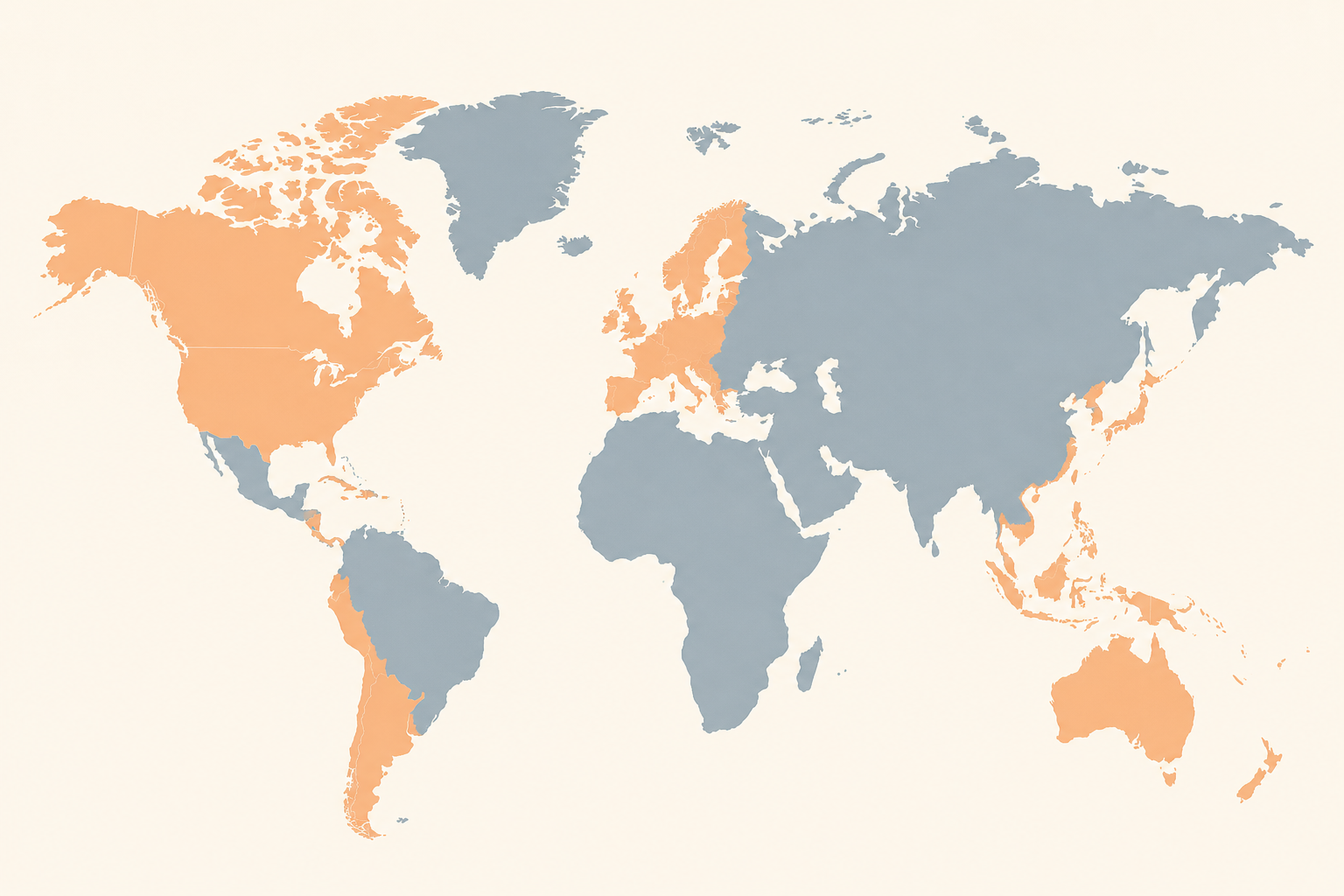
Europe (35)
France, Germany, Italy, the Netherlands, Spain, Switzerland, Ireland, Hungary, Austria, Belgium, Luxembourg, Poland, Slovenia, Portugal, Greece, Cyprus, Slovakia, Norway, Finland, Denmark, Iceland, Andorra, Monaco, Liechtenstein, Bulgaria, Romania, Croatia, Montenegro, North Macedonia, Malta, Estonia, Latvia, Russia, Sweden, United Kingdom.
Oceania (2)
Australia, New Zealand
Asia (7)
Brunei, Republic of Korea (South Korea), Japan, Saudi Arabia, Oman, Kuwait, Bahrain
Americas (6)
Brazil, Argentina, Chile, Peru, Uruguay, Canada
Note: UK and Canada were expanded onto the unilateral list in February 2026, joining most of Western Europe, Japan, Australia, and others. Always re-check the live NIA page before departure in case of additions.
World map highlight of visa-free regions — Europe, Oceania, and select Asia-Pacific and Americas.
3. Policy validity dates
Embassy FAQs and NIA materials cite these windows (extensions may be announced):
| Country/group | Valid through |
|---|---|
| Brunei | No fixed expiry stated |
| Russia | 31 December 2027 (MFA FAQ; reconfirm before travel) |
| Other 48 countries | 31 December 2026 |
If you travel near a deadline, check MFA and your embassy for renewal announcements before buying non-refundable fares.
4. How the 30 days are counted
This trips up even experienced travelers:
- The clock starts at 00:00 on the day after entry (入境次日零时起算)
- You receive 30 calendar days, not "720 hours from landing time"
- Example: Enter 6 August → counting begins 7 August 00:00 → permitted stay through 5 September 00:00 boundary (verify exact exit date with your airline and hotel)
Plan your exit before the permitted window closes. Overstaying triggers fines and can affect future visas.
5. Allowed activities and limits
Permitted (examples):
- Sightseeing and independent tourism
- Business meetings and trade fairs (not employment)
- Visiting friends and relatives
- Short cultural or academic exchange
- Transit across China within 30 days
- Sports events, exhibitions, summer/winter study camps within 30 days
Not permitted on visa-free entry:
- Taking paid employment in China
- Degree-seeking study or long-term language programs
- News reporting without a J visa
- Any activity inconsistent with what you declare at immigration
There is no published hard cap on how many times you may use the waiver, but officers expect genuine short visits—back-to-back 30-day "living" patterns may draw scrutiny.
6. Documents to carry (no embassy pre-approval)
You do not file anything at an embassy before travel, but immigration may ask for:
- Passport valid for the entire trip
- Return or onward ticket (showing you will leave within 30 days)
- Hotel confirmations or host address in Chinese and English
- Invitation letter if staying with friends or attending a hosted event
- Business cards or meeting agenda if purpose is commercial
- Completed Arrival Card QR from official portal — free, filed within ~72 hours before landing
Tip: Carry printed backups even if you rely on phone apps—dead batteries happen at the worst counter.
7. United States exclusion — what Americans should do
U.S. ordinary passport holders are not on the 30-day unilateral list. Popular alternatives:
- 240-hour transit visa-free if your routing is Country A → Mainland China → Third country/region (not back to the U.S.) within 240 hours — transit guide
- Tourist (L) visa via COVA + CVASC for classic multi-city trips — simplified documents for many U.S. applicants (ultimate guide)
- Hainan-only beach holiday if entering directly via Hainan and nationality is on the 59-country Hainan list — Hainan guide
Do not assume EU friends' visa-free status applies to your U.S. passport.
8. Multiple entries and long stays
- Multiple entries: Currently allowed without a published visit cap, but each stay must respect the 30-day per entry rule and declared purpose.
- Need 31+ days? Apply for an L or other visa before travel, or after entry apply for a stay permit at Exit-Entry Administration with legitimate justification—do not simply overstay.
- Tibet: Visa-free mainland entry does not replace Tibet Travel Permit requirements.
9. FAQ
Do I need to register anywhere before flying?
No embassy registration for unilateral waiver. Do file the Arrival Card online before landing.
Can I fly into Beijing and exit from Guangzhou?
Yes—this is nationwide mainland waiver, not port-locked like some transit rules (still use eligible open ports).
Does visa-free cover Hong Kong or Macao?
No—those are separate SAR entry regimes.
Can my travel agent "add me" to visa-free?
No—eligibility is strictly nationality + purpose + stay length. Agents help itineraries, not immigration classification.
What if policy expires while I am in China?
Your entry permission is governed by rules at time of entry; still, monitor extensions if you plan repeat visits near year-end 2027.
China 240-Hour Transit Visa-Free (ex-144 Hours)
Search engines and older guidebooks still say "144-hour visa-free transit." In 2026 the operative policy for eligible travelers is 240 hours—effectively ten days—to explore designated parts of mainland China while en route to another country or region. This is a powerful option for U.S. passport holders (who are not on the 30-day unilateral list) and for anyone wanting a stopover holiday without a full tourist visa—if your routing and tickets are correct.
1. 144 vs 240 hours — what changed?
- Legacy name: Travel forums, OTAs, and even some airline pages still print "144-hour" or "6-day" transit.
- Current standard: NIA's 240-hour visa-free transit for 55 countries—roughly 10 days from the day-after-entry counting method (same calendar-day logic as other waivers).
- Practical impact: More time for Beijing + Xi'an, Shanghai + Hangzhou, or Chengdu + Guilin combinations without a visa appointment overseas.
Always tell immigration you are using the 240-hour transit visa-free policy and carry proof of your onward third-country/region ticket within the window.
2. Eligible nationalities (55 countries)
Per NIA compilations:
Americas (6): United States, Canada, Brazil, Mexico, Argentina, Chile
Europe (40): Albania, Austria, Belarus, Belgium, Bosnia and Herzegovina, Bulgaria, Croatia, Cyprus, Czech Republic, Denmark, Estonia, Finland, France, Germany, Greece, Hungary, Iceland, Ireland, Italy, Latvia, Lithuania, Luxembourg, North Macedonia, Malta, Monaco, Montenegro, Netherlands, Norway, Poland, Portugal, Serbia, Slovakia, Slovenia, Spain, Sweden, Switzerland, Romania, Russia, United Kingdom, Ukraine
Oceania (2): Australia, New Zealand
Asia (7): Republic of Korea, Japan, Singapore, Brunei, United Arab Emirates, Qatar, Indonesia
Note: Overlap with the 30-day unilateral list is large but not identical. If you qualify for both, pick the policy that matches your ticket pattern and stay length—transit requires a third-country onward route; 30-day unilateral does not.
3. The third-country rule — non-negotiable
The single largest denial reason is wrong routing.
You MUST hold a confirmed onward ticket to a third country or region (not your country of origin as the immediate next destination after China).
| Routing | Result |
|---|---|
| USA → Shanghai → Tokyo → USA later | Usually OK — Japan is third country |
| UK → Beijing → Hong Kong | Usually OK — HK often counts as separate region |
| USA → Beijing → USA direct | NOT OK — returning home is not transit to a third country |
| Canada → Guangzhou → Canada | NOT OK |
Hong Kong, Macao, and Taiwan are frequently treated as separate regions for onward travel purposes—but airline check-in staff and border officers may interpret edge cases differently. Confirm with your carrier and keep ticket printouts showing separate ticket numbers or distinct destinations.
Round-the-world tickets and open-jaw itineraries work when the next country/region after China is genuinely third-party on paper.
Tip: A separate paid ticket to Japan or HK is safer than a "dummy" reservation—officers can verify.
4. Ports, regions, and cross-province travel
Coverage:
- Entry via designated ports across 24 provincial-level regions (recent expansions cite ~65 ports nationwide—air, rail, and sea where published)
- Common hubs: Beijing Capital/Daxing, Shanghai Pudong/Hongqiao, Guangzhou Baiyun, Chengdu Tianfu/Shuangliu, Xi'an Xianyang, Hangzhou, Kunming, Xiamen, Qingdao, Tianjin, and more
Geographic scope:
- You must remain within permitted administrative areas tied to your entry region policy
- Cross-province travel is generally allowed within allowed regions—for example Beijing entry with travel to Shanghai is commonly cited as permitted under current guidance, unlike older stricter 144-hour maps
- You cannot use transit waiver to visit Tibet or other restricted zones without separate permits
Both entry and exit must occur through eligible ports within the 240-hour window. Verify your exit airport or land border is on the current list.
Airport transfer hall at a major Chinese hub — confirm both entry and exit ports qualify.

5. 24-hour transit — different beast
China also offers 24-hour visa-free transit at all open ports for worldwide travelers who:
- Have onward tickets to a third country/region
- Remain inside the port's restricted transit area without clearing immigration into the city (airside transfer)
Use 24-hour when you do not want to enter China proper—tight connections only. If you want to leave the airport and sightsee, you need 240-hour (if nationality eligible) or a visa.
6. Allowed activities and prohibited ones
Generally allowed during 240-hour stay:
- Tourism and sightseeing
- Business meetings (not employment)
- Visiting friends or family
- Short cultural visits
Still require advance visas:
- Work, paid employment
- Study programs
- News reporting / journalism
Complete hotel registration; carry passport and onward ticket when moving between cities.
7. Arrival Card and port procedure
Since 20 November 2025, transit travelers also file the free digital Arrival Card:
- URL: https://s.nia.gov.cn/ArrivalCardFillingPC/
- Select the matching entry policy on the form (240-hour transit)
- Save QR offline; present at immigration with passport and onward ticket
At the booth, state transit visa-free 240-hour clearly. Officers stamp permitted stay—verify dates before leaving the counter.
8. Common mistakes that cause denial
- Return ticket only — USA→China→USA without a third country
- Open jaw confusion — same-country "triangle" that does not count as third region
- Overstay — treating 240 hours as "about ten days" without checking calendar cutoff
- Wrong exit port — entering Shanghai but exiting via a non-eligible land border
- Purpose mismatch — attending paid work or long training on transit status
- No Arrival Card — delays and extra questioning (rarely sole denial reason but avoidable)
- Assuming 144-hour old maps — outdated port lists from 2018 blog posts
Note: Airlines may deny boarding if they believe you lack mainland entry permission—fix tickets before the airport, not at immigration.
9. Sample itineraries that work
U.S. traveler — 8-day culture stop
- Route: Los Angeles → Beijing (5 nights) → Seoul → Los Angeles
- Policy: 240-hour transit; onward ticket to South Korea satisfies third-country rule
- Exit: Beijing Capital international departure to Incheon
Australian traveler — also on 30-day list
- Could use either 30-day unilateral or 240-hour transit
- If round trip is Sydney → Shanghai → Sydney with no third country, 30-day unilateral is the correct path—not transit
UK traveler — HK open jaw
- London → Guangzhou → Hong Kong (third region) → London
- Transit waiver for mainland segment; HK entry under SAR rules
East Marvel builds transit-friendly stopovers with buffer days and eligible exit ports: chinatour.eastmarvel.com.
10. FAQ
Is 144-hour still valid at all?
Use 240-hour as the planning baseline; leftover "144" labels are outdated marketing.
Can I enter visa-free for 30 days AND use transit later same trip?
Each entry is judged separately—do not mix policies on one entry stamp.
Do I need hotels booked for every night?
Strongly recommended; officers may ask for accommodation proof.
Can cruise passengers use 240-hour?
Verify port-of-call and immigration guidance—cruise rules differ; ask your operator and NIA notices.
What if my onward flight is cancelled?
Contact airline and Exit-Entry Administration immediately—overstay risk is real.
Hainan 30-Day Regional Visa-Free
Sun, sea, and surf draw millions to Hainan—China's southernmost province and a standalone tourism zone with its own 30-day visa-free entry track. Unlike the nationwide 30-day unilateral waiver, Hainan's policy is regional: you must enter through Hainan's open ports and, if you rely on the Hainan-only list, your activities stay inside Hainan Province. Official materials also describe a combined ~86-country figure when national visa-free policies stack—this page explains both numbers without confusion.
Source: Hainan / NIA policy summaries · Hainan government portal
1. Two numbers you will see: 59 and ~86
Travel articles disagree because they mix policy layers:
Hainan regional visa-free — 59 countries
This is Hainan's standalone list: ordinary-passport holders from these 59 countries may enter visa-free for up to 30 days for tourism, business, visits, family, medical care, conferences, exhibitions, sports, and similar short purposes (work and study excluded). Activity area is Hainan Province when entering under this regional track alone.
Nationwide visa-free — ~74 countries (27 bilateral + 47 unilateral, with overlaps)
China's national exemptions—bilateral mutual visa-free treaties plus the 47-country unilateral 30-day list (part of the broader 50-country unilateral compilation)—apply at all mainland open ports, including Hainan.
Combined ~86 countries in Hainan official explainers
Hainan government materials describe stacking:
- 74 nationalities covered by nationwide visa-free policies can enter China (including Hainan) under those national rules
- 11 countries on the Hainan 59 list are not fully covered by the national unilateral/bilateral lists for general mainland travel—but can still use Hainan regional visa-free when meeting Hainan entry conditions
Those 11 Hainan-specific nationalities commonly cited include: United States, Canada, Mexico, Philippines, Indonesia, Lithuania, Czech Republic, Sweden, United Kingdom, Ukraine, Russia (exact accounting can shift with policy updates—verify before booking).
Formula often printed: 74 (national) + 11 (Hainan-only additions) ≈ 85–86 countries depending on counting overlaps and minor policy adjustments.
2. Full 59-country list by region
Per NIA / Hainan official compilations:
Europe (40): France, Netherlands, Belgium, Luxembourg, Germany, Switzerland, Austria, Portugal, Spain, Monaco, Italy, Cyprus, Malta, United Kingdom, Ireland, Iceland, Finland, Norway, Sweden, Denmark, Estonia, Latvia, Lithuania, Greece, Albania, Bosnia and Herzegovina, Bulgaria, Croatia, Czech Republic, Hungary, Montenegro, North Macedonia, Poland, Romania, Serbia, Slovakia, Slovenia, Russia, Belarus, Ukraine
Americas (6): United States, Canada, Mexico, Brazil, Argentina, Chile
Oceania (2): Australia, New Zealand
Asia (11): Japan, Republic of Korea, Singapore, Brunei, UAE, Qatar, Malaysia, Thailand, Kazakhstan, Philippines, Indonesia
Note: U.S. passport holders appear here but not on the nationwide 30-day unilateral list—Hainan direct entry is a realistic visa-free beach option Americans often overlook.
3. Critical rule: enter Hainan directly
You cannot use Hainan regional visa-free if you first enter mainland China elsewhere:
- Wrong: London → Beijing (needs visa or national waiver) → flight to Sanya
- Right: London → Haikou Meilan or Sanya Phoenix direct (if nationality eligible under the policy layer you claim)
Connecting through Hong Kong or another Chinese city before Hainan may destroy Hainan-only eligibility—plan international flights that land in Hainan first.
4. You cannot freely continue to Beijing or Shanghai
Hainan regional visa-free does not authorize independent travel to other mainland provinces on that entry alone.
- Stay in Hainan for resorts, diving, rainforests, and Boao conferences
- Need Beijing or Xi'an? Apply for an L visa or use a national 30-day waiver if your nationality qualifies—not Hainan-only status
- Leaving Hainan for other provinces typically requires advance visa application with Hainan public security exit-entry authorities (per official guidance)—do not assume you can "add on" cities mid-trip
Nationwide visa-free travelers (e.g., French or Japanese ordinary passports) entering Hainan under national policy may continue elsewhere in China within their 30-day national allowance—that is a different policy layer from Hainan-only 59-country regional entry.
5. Entry ports and stay counting
Common open ports:
- Haikou Meilan International Airport
- Sanya Phoenix International Airport
- Qionghai Boao Airport (regional traffic)
- Selected seaports: Yangpu, Haikou, Qinglan, Basuo, Sanya (verify cruise and ferry schedules)
Stay length: Up to 30 calendar days, counted from 00:00 the day after entry (consistent with other visa-free policies).
Purposes expanded since 2024: Beyond tourism—business, visits, family, medical tourism, MICE events, sports—still excluding employment and degree study.
Sanya beach and Phoenix International Airport — plan direct international arrival.
6. Documents and Arrival Card
Even without a visa vignette, carry:
- Valid ordinary passport
- Return or onward ticket within 30 days
- Hotel bookings in Hainan (English + Chinese address)
- Event or hospital appointment letters if purpose is MICE or medical
- Free Arrival Card QR from https://s.nia.gov.cn/ArrivalCardFillingPC/ — select the correct policy category
Immigration may ask how you qualify—state Hainan visa-free or national visa-free clearly depending on your nationality layer.
7. Hainan vs nationwide 30-day — quick pick
| Question | Choose national 30-day | Choose Hainan regional 59 |
|---|---|---|
| Want Beijing + Hainan same trip? | Yes, if nationality on 50-country list | No—Hainan-only cannot freely add Beijing |
| U.S. passport, beach week only, direct to Sanya? | Not eligible nationally | Yes — Hainan 59 list includes USA |
| EU passport, 2 weeks Sanya only? | Either works if entering Hainan under national waiver | Regional also works |
| Enter Guangzhou first? | Need visa or national waiver at first port | Hainan-only ** fails** |
8. FAQ
Is Hainan visa-free the same as "visa free China"?
No—it is provincial unless you enter under a national exemption that also covers other cities.
Can I use 240-hour transit to Hainan then stay 30 days?
Transit and Hainan regional waivers are different clocks and conditions—do not stack without official basis.
Group tours vs FIT?
Independent travel is common on eligible visa-free entry; certain legacy group schemes may still exist for niche markets—verify with operator.
Does East Marvel run Hainan packages?
Yes—we design Sanya, Haikou, and rain-forest extensions and confirm entry port + nationality layer before you pay: chinatour.eastmarvel.com.

China Visa Exemptions Map — Overlaps & Special Cases
"Is China visa-free for tourists?" is the wrong question in 2027. The right question is: which exemption layer matches my passport, ports, and ticket pattern? Immigration officers apply specific legal bases—not marketing slogans. This reference maps every major tourist-relevant exemption, how they interact, and where they do not overlap.
Tip: Exemptions cover entry permission, not every regional permit (e.g., Tibet Travel Permit is separate). East Marvel reviews itineraries at chinatour.eastmarvel.com but does not issue visas.
1. Master map — six exemption families
(Detail for unilateral 30-day, 240-hour transit, and Hainan is in the sections above—use this map for overlaps and niche cases.)
| # | Exemption type | Who it targets | Typical max stay | Advance embassy? |
|---|---|---|---|---|
| 1 | Bilateral mutual visa-free | Treaty-listed nationalities & passport types | Varies by treaty (often 15–90 days) | No |
| 2 | Unilateral 30-day visa-free | 50 ordinary-passport countries | 30 calendar days | No |
| 3 | 240-hour transit visa-free | 55 countries, third-country ticket | ~10 days | No |
| 4 | 24-hour airside transit | Worldwide, stay in port area | 24 hours | No |
| 5 | Hainan regional 30-day | 59-country core list / ~86 stacked | 30 days in Hainan | No |
| 6 | Special documents & group schemes | APEC ABTC, certain group visas, diplomatic passports | Case-by-case | Sometimes |
If none fit → L tourist visa or other visa category via embassy/CVASC.
2. Hong Kong, Macao — not mainland exemptions
Hong Kong and Macao SARs operate independent visa-free regimes for many nationalities. Common durations differ from mainland rules.
Critical: HK/Macao visa-free entry does not substitute for mainland permission. Combined itineraries need two legal analyses:
- SAR entry (HK Immigration / Macao Public Security)
- Mainland entry (exemption or visa)
Third-region routing for 240-hour transit often uses HK/Macao as the onward destination after mainland—distinct from SAR standalone visits.
3. Group visa-free and organized tour schemes
China historically operated group visa-free programs for certain nationalities traveling with licensed Chinese agencies (often fixed itineraries, group size minimums, pre-registration). These are narrower than individual 30-day unilateral entry.
2027 practical note: Individual unilateral and transit waivers reduced reliance on group schemes for many markets—but cruise groups, MICE delegations, or niche country arrangements may still use group channels. If a tour operator cites "group visa-free," verify:
- Is it Hainan group, transit group, or a legacy bilateral group program?
- Does it require pre-approved passenger lists and fixed ports?
East Marvel can clarify when you book—always match operator paperwork to immigration law.
4. APEC Business Travel Card (ABTC) — light note
Certain APEC Business Travel Card holders received expedited entry privileges including short business visits to China without a separate visa vignette when card validity and matching passport align with current NIA rules.
Tourist relevance: Limited. ABTC targets business travel, not sightseeing holidays. Leisure travelers should not plan a Great Wall trip on ABTC alone. Cardholders must carry passport + valid ABTC and respect purpose limits.
Policy details change—corporate travelers should confirm with NIA and card issuers before each trip.
5. What exemptions do NOT cover
Regardless of exemption type, these generally still need visas or permits:
| Situation | Required |
|---|---|
| Paid employment in China | Z work visa + permits |
| Degree study | X1/X2 student visa |
| Journalism | J1/J2 visa |
| Foreign media filming beyond tourist snapshots | Press accreditation |
| Tibet for foreigners | Tibet Travel Permit + licensed tour |
| Stay beyond exemption limit | Stay permit or visa before overstay |
| Port visa as leisure default | Not recommended — restricted emergency path |
6. Choosing among overlapping exemptions
Many travelers qualify for more than one policy on paper. Selection criteria:
- Ticket pattern: No third country? → Not transit.
- Stay length: Over 10 days but under 30? → 30-day unilateral beats 240-hour.
- Geography: Only Hainan beaches, U.S. passport? → Hainan 59 beats L visa.
- Multi-city mainland: National 30-day beats Hainan regional.
- **Stopover under 10 days, U.S. passport, USA→China→Japan? → 240-hour transit.
Document the policy name you will declare at immigration and on the Arrival Card.
7. Universal steps after any exemption
Every exemption path still requires:
- Valid ordinary passport (unless treaty specifies other passport types)
- Arrival Card at https://s.nia.gov.cn/ArrivalCardFillingPC/ (free)
- Supporting proof (tickets, hotels, invitations)
- Customs declaration when required
- Temporary accommodation registration (hotels auto-register; private stays manual)
Related reading (this 4-part series)
- China Visa-Free Entry Guide
- China Visa Types & Requirements
- China Visa Application Guide
- China Entry & Exit Rules
Official sources hub
- National Immigration Administration (NIA): https://www.nia.gov.cn/
- Arrival Card (free): https://s.nia.gov.cn/ArrivalCardFillingPC/
- General Administration of Customs (GACC) English: http://english.customs.gov.cn/
- State Taxation Administration (STA) tax refund: https://www.chinatax.gov.cn/eng/c101276/c102444/c5240901/content.html
- Customs Announcement 43 (2025): https://www.gov.cn/zhengce/zhengceku/202504/content_7017195.htm
- MFA visa-free FAQ: https://www.mfa.gov.cn/wjbzwfwpt/kzx/tzgg/202511/t20251110_11749824.html
- Visa Application Service Center (COVA): https://www.visaforchina.cn/
Plan with East Marvel
Practical tips—not legal advice. For itinerary review and tax-refund-friendly routing: